

MAOI Tyramine Content Checker
Check Your Food Safety
Enter a food or beverage to see if it's safe with MAOIs. This tool helps identify tyramine content based on current medical guidelines.
Enter a food or beverage to check its safety
Type a food or drink name above to see if it's safe while taking MAOIs.
Common Safe & Unsafe Foods
Quick reference guide based on current medical guidelines:
SAFE FOODS:
UNSAFE FOODS:
Why MAOIs Are Still Used Despite the Risks
Most people start antidepressants hoping for relief without major lifestyle changes. But for those with treatment-resistant depression - the kind that doesn’t respond to SSRIs, SNRIs, or even multiple medication trials - monoamine oxidase inhibitors (MAOIs) can be the only thing that works. These drugs, first discovered in the 1950s, don’t just tweak one neurotransmitter. They flood the brain with serotonin, norepinephrine, and dopamine by blocking the enzyme that breaks them down. That’s powerful. And it’s why, even today, MAOIs like phenelzine and tranylcypromine remain in use, despite being prescribed in less than 1% of antidepressant cases in the U.S.
They’re not first-line drugs for a reason. Unlike newer antidepressants, MAOIs come with strict rules: no aged cheese, no soy sauce, no cold medicine without checking the label. But for some, the trade-off is worth it. A 2021 meta-analysis in the American Journal of Psychiatry found that 50-60% of patients who had tried four or more other antidepressants without success saw real improvement on MAOIs. That’s not a small number. It’s the difference between staying bedridden and getting back to work, to family, to life.
How MAOIs Work - And Why That’s Both a Gift and a Danger
MAOIs block monoamine oxidase, an enzyme that normally cleans up excess neurotransmitters in the brain. There are two types: MAO-A and MAO-B. MAO-A is the main target for depression treatment because it breaks down serotonin and norepinephrine. When you inhibit it, those mood-lifting chemicals build up. That’s the good part.
The bad part? That same enzyme also breaks down tyramine - a compound found in aged, fermented, or spoiled foods. Normally, your gut handles tyramine without issue. But when MAO-A is switched off, tyramine slips into your bloodstream, triggers a massive release of norepinephrine, and sends your blood pressure skyrocketing. This isn’t a minor headache. It’s a hypertensive crisis - systolic pressure can hit 200 mmHg or higher. Symptoms include pounding headache, blurred vision, chest pain, nausea. Left untreated, it can cause stroke or heart attack.
That’s why the FDA requires a black box warning on all oral MAOIs. It’s the strongest safety alert they give. And it’s not just theoretical. Real people have ended up in the ER because they ate blue cheese on a pizza or drank a craft beer without knowing the risk.
The Tyramine Diet: What You Can’t Eat (And What’s Safe)
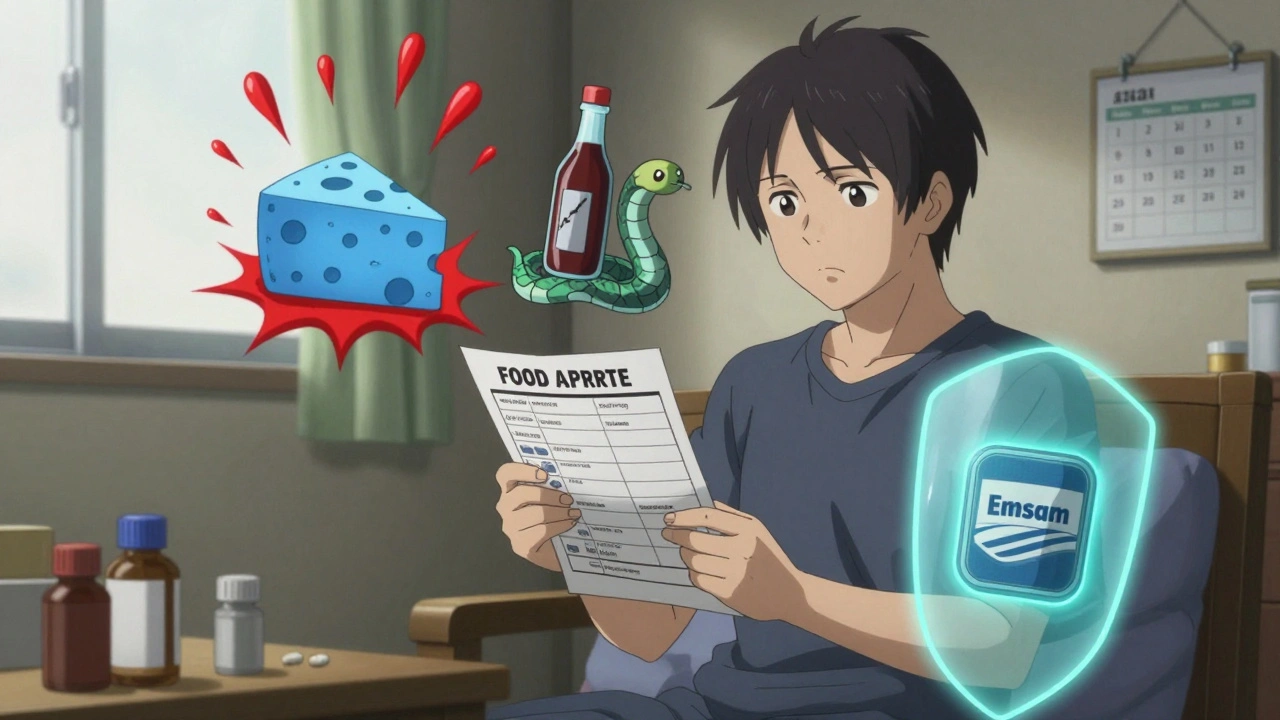
If you’re on an MAOI, food isn’t just about taste anymore - it’s a safety checklist. You need to avoid anything aged, fermented, or stored too long. Here’s what to skip:
- Aged cheeses: Cheddar, Swiss, blue cheese, Parmesan - any that’s been sitting for weeks or months. Even some "fresh" cheeses like brie or camembert can be risky if not stored properly.
- Cured or smoked meats: Salami, pepperoni, liverwurst, pickled herring. These contain high levels of tyramine.
- Fermented soy: Soy sauce, miso, tofu that’s been aged, tempeh. Even a tablespoon of soy sauce can push you over the edge.
- Tap beer and draft wine: These often contain live yeast and higher tyramine than bottled versions. Stick to bottled beer or wine, and keep it under 4 oz.
- Overripe fruits: Bananas, avocados, figs - especially if they’re brown-spotted or left out too long.
- Leftovers over 48 hours: If it’s been sitting in the fridge for more than two days, it’s probably not safe.
Safe options? Fresh meat, plain dairy like cottage cheese or ricotta, freshly baked bread, most vegetables, and fruits eaten right after buying. A 2023 Mayo Clinic guide says you can have up to 6 mg of tyramine per serving - but most people don’t know how to measure that. So the safest rule is: when in doubt, don’t eat it.
Many patients keep a food diary for the first few months. Some even use apps that track tyramine content. One Reddit user, ChronicDepressor87, shared: "I carry a printed list in my wallet. I show it to waiters. I’ve canceled dates because I couldn’t risk the food."
Drug Interactions: The Hidden Triggers
It’s not just food. Medications can be just as dangerous. MAOIs can cause serotonin syndrome - a life-threatening surge in serotonin - if taken with SSRIs, SNRIs, tramadol, dextromethorphan (found in cough syrups), or even St. John’s Wort. The risk is highest if you switch from one antidepressant to another without waiting long enough.
That’s why doctors require a 2-5 week washout period before starting an MAOI after stopping another antidepressant. And you can’t just switch back the same way. If you want to go off MAOIs, you have to wait at least two weeks after stopping them before starting an SSRI.
Even over-the-counter cold meds are risky. Pseudoephedrine, found in Sudafed and many allergy remedies, can cause dangerous spikes in blood pressure. Decongestant nasal sprays? Same problem. Always check labels. Ask your pharmacist. Don’t assume something is safe because it’s "just a cold pill."
The Patch That Changed Everything: Emsam
Not all MAOIs are created equal. The transdermal selegiline patch (Emsam), approved in 2006, offers a major advantage: lower doses don’t require dietary changes. At 6 mg/24hr, it’s absorbed through the skin and doesn’t block MAO-A in the gut - so tyramine gets broken down normally. Only when you go up to 9 mg or 12 mg do you need to follow the full diet.
That’s huge. A 2023 study showed that 92% of people on oral MAOIs needed strict diet control. Only 8% of those on the 6 mg patch did. It’s also easier on the stomach - no nausea, no dry mouth, fewer side effects. But it’s expensive: $850-$1,200 a month, compared to $30-$50 for generic phenelzine. Insurance doesn’t always cover it. Still, for many, it’s the only way to stay on MAOIs without living in fear of their dinner.
Who Benefits Most - And Who Should Avoid Them
MAOIs aren’t for everyone. They’re best suited for:
- People with treatment-resistant depression who’ve tried at least three other antidepressants without success
- Those with atypical depression - symptoms like oversleeping, overeating, heavy limbs, and mood reactivity
- Patients who can commit to strict dietary rules and regular follow-ups
They’re not recommended for:
- People with uncontrolled high blood pressure
- Those with liver disease
- Anyone who can’t or won’t avoid tyramine-rich foods
- People taking other medications that interact with MAOIs
And while they’re sometimes used for anxiety or panic disorders, they’re not first-choice for those conditions. SSRIs and therapy usually work better.

Real Lives, Real Trade-Offs
On Reddit’s r/antidepressants, a 2023 thread with over 1,200 comments revealed a pattern: people who stayed on MAOIs for more than a year were almost all treatment-resistant. Many said they’d been suicidal before starting. Afterward, they felt like themselves again.
"I was a ghost," wrote one user. "Now I cook for my kids. I go for walks. I laugh. But I can’t eat at a restaurant without reading every ingredient. I don’t travel much. I don’t date. It’s isolating. But I’m alive. That’s enough."
Others weren’t so lucky. One user had two hypertensive crises - both from accidentally eating fermented soy. Another had to stop because the anxiety of watching every bite became worse than the depression.
Still, a 2022 survey by the Depression and Bipolar Support Alliance found that 65% of MAOI users stayed on treatment for over two years - compared to just 42% of those on SSRIs in the same group. The restrictions are hard. But for some, the alternative is worse.
What’s Next for MAOIs?
Researchers aren’t giving up. A new experimental MAO-A inhibitor, AZD7325, showed in early trials that it reduces tyramine sensitivity by 70%. That could mean fewer dietary rules. The National Institute of Mental Health is funding studies on MAOIs for bipolar depression, with early results showing a 55% remission rate.
Meanwhile, Europe already has moclobemide (Aurorix), a reversible MAOI that’s safer and doesn’t require a strict diet. It’s not available in the U.S., but if it gets approved, it could change the game.
For now, MAOIs remain a last-resort tool - powerful, risky, and deeply personal. They’re not for everyone. But for the right person, they’re not just another pill. They’re a lifeline.
Can I drink alcohol on MAOIs?
It’s risky. Some alcoholic drinks, especially tap beer, red wine, and fermented beverages, contain tyramine. Even small amounts can trigger a blood pressure spike. If you want to drink, stick to a small glass of fresh, bottled wine or clear liquor like vodka or gin - and only after checking with your doctor. Never mix alcohol with MAOIs without medical advice.
How long do I need to stay on an MAOI before seeing results?
It usually takes 2 to 6 weeks to notice improvement, though some people feel changes as early as 10 days. Unlike SSRIs, which often cause initial side effects before helping, MAOIs can improve energy and mood before anxiety or sleep issues clear up. Patience is key - and don’t stop early just because you don’t feel better right away.
Are MAOIs addictive?
No, MAOIs are not addictive. You won’t get high from them, and they don’t cause cravings. But stopping them suddenly can cause withdrawal symptoms like dizziness, nausea, and irritability. Always taper off under medical supervision - never quit cold turkey.
Can I take MAOIs if I have high blood pressure?
Not if your blood pressure is uncontrolled. MAOIs can cause dangerous spikes, especially with tyramine exposure. If you have high blood pressure, you need to get it stable first - and even then, you’ll need close monitoring. Some patients with well-managed hypertension can use MAOIs safely, but only under a psychiatrist’s watch.
What should I do if I accidentally eat something with tyramine?
If you feel a sudden headache, chest tightness, rapid heartbeat, or blurred vision, sit down and call 911 immediately. Some doctors prescribe phentolamine (5-10 mg) to keep on hand - take it under the tongue if symptoms start. Don’t wait. A hypertensive crisis can turn deadly within minutes.
Why aren’t MAOIs prescribed more often?
Because they’re complicated. Most doctors aren’t trained in managing dietary restrictions or drug interactions. Patients often don’t want to follow the rules. And with safer alternatives like SSRIs available, there’s little incentive to take the risk - unless you’ve tried everything else. But for treatment-resistant depression, MAOIs remain one of the most effective options we have.
Final Thoughts: Is It Worth It?
MAOIs aren’t for the faint of heart. They demand discipline, awareness, and constant vigilance. But for the person who’s tried everything else - who’s lost years to depression, who’s stared at the ceiling wondering if relief will ever come - they offer something rare: a real chance at recovery. The restrictions are real. The risks are serious. But so is the reward.
If you’re considering an MAOI, talk to a psychiatrist who’s experienced with them. Get the education. Ask for a dietitian. Carry your emergency meds. Don’t be afraid to ask questions. This isn’t just about taking a pill. It’s about rebuilding your life - one careful meal, one honest conversation, one safe day at a time.



Post A Comment