
When you pick up a generic pill at the pharmacy, you’re saving money - often hundreds of dollars compared to the brand-name version. But behind that simple exchange is a complex, costly, and sometimes broken regulatory system. The FDA’s approval process for generic drugs isn’t just paperwork. It’s a financial gauntlet that can cost manufacturers millions, delay patient access, and ultimately affect how much you pay out of pocket.
What You’re Really Paying For
Most people assume generic drugs are cheaper because they’re copied. But that’s not the full story. Generic manufacturers don’t just replicate a brand-name drug. They must prove it’s bioequivalent - meaning it works the same way in your body. That’s not easy, especially for complex drugs like inhalers, injectables, or topical creams. And the FDA doesn’t make it simple.
The system runs on the Generic Drug User Fee Amendments (GDUFA) a program created in 2012 to fund FDA reviews of generic drug applications. Since then, the FDA has collected over $1.3 billion in fees from generic drug companies. For FY 2025, the total fee structure is $638.9 million, with $210.8 million coming directly from ANDA (Abbreviated New Drug Application) the formal submission required to get a generic drug approved fees alone. That’s not a one-time cost. Each drug application costs $136,485. Add facility fees ($238,055 per manufacturing site) and you’re looking at $375,000 just to file.
Compare that to brand-name drugs. Under the Prescription Drug User Fee Act (PDUFA) the fee program for brand-name drug approvals, a single New Drug Application (NDA) costs $3.685 million. So yes, generics are cheaper to approve - but the cost is still massive for small companies.
The Hidden Cost: The 2015 Policy Change
The real problem isn’t the fee. It’s what happens after you submit your application.
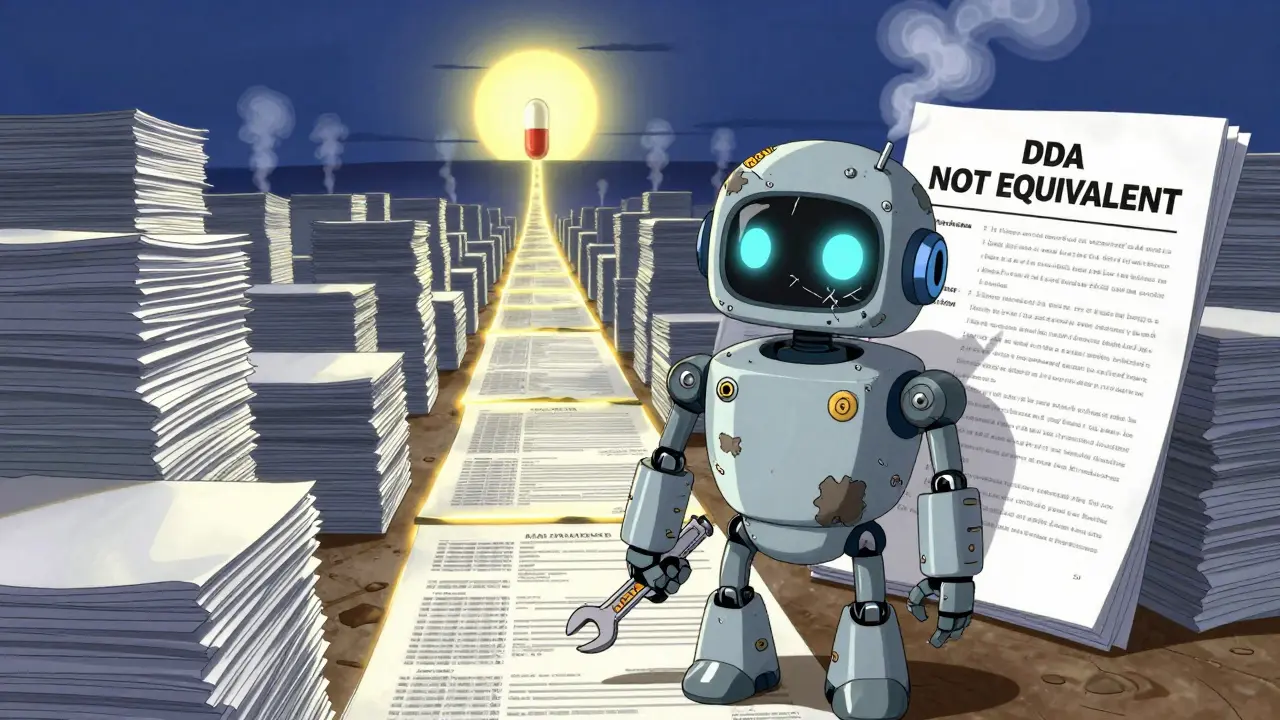
In 2015, the FDA stopped giving manufacturers specific feedback on formulation differences for complex generics. Before that, if your nasal spray didn’t match the brand’s spray pattern, the FDA would say: "Your droplet size is off by 15%." Now? They say: "Your product isn’t equivalent." No details. No direction. Just a rejection.
This single change turned approval into a guessing game. One mid-sized generic manufacturer told RAPS in 2024 they spent $8.7 million on three failed reformulations of a single nasal spray product since 2018. Each attempt took 18 months. Each failure meant another $2 million in costs. That’s not innovation - that’s regulatory roulette.
Result? Approval times for complex generics average 14 months longer than for simple pills. First-cycle approval rates? Just 42% for complex drugs versus 65% for standard ones. That’s not inefficiency. It’s a bottleneck.
Who Pays the Price?
It’s not just the drugmakers. It’s you.
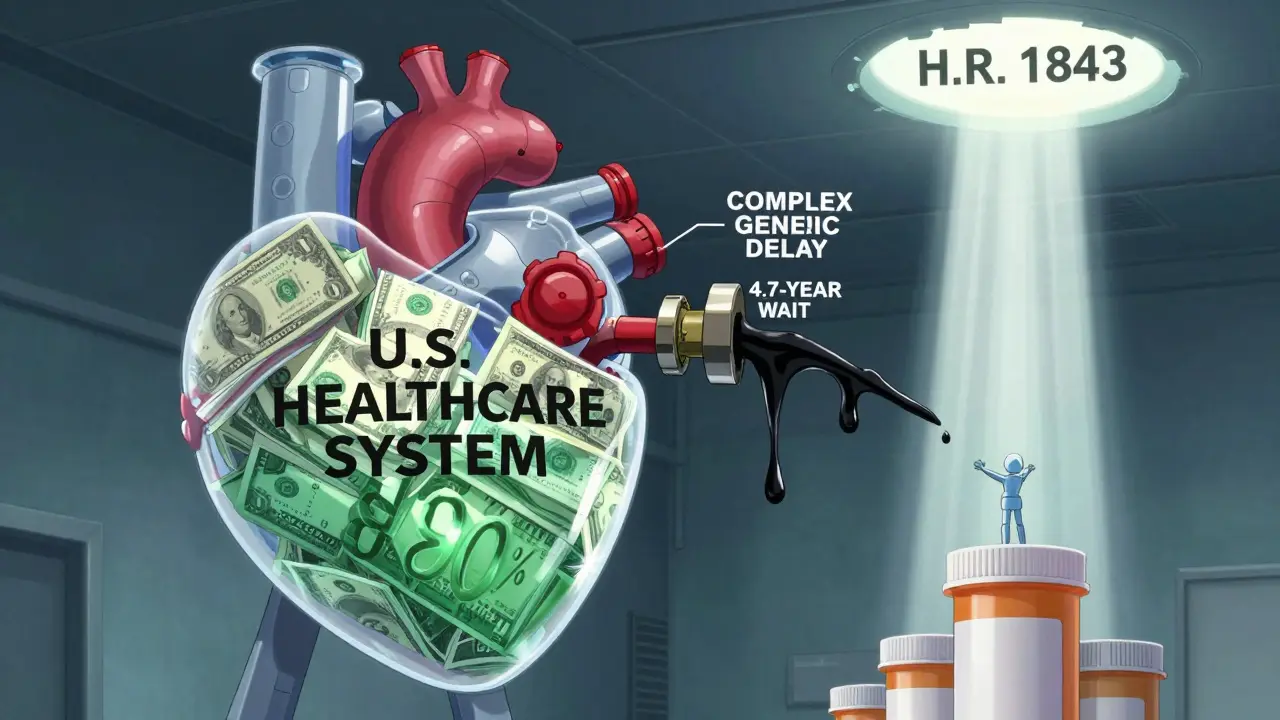
Between 2016 and 2020, generic versions of testosterone replacement therapy were delayed by 4.7 years. During that time, patients paid up to 300% more for the brand-name version. That’s not coincidence. It’s a direct result of approval delays.
On Reddit’s r/pharmacy, over 140 patients shared stories in 2025 about being forced to pay $1,200 a month for a drug like apixaban or glipizide - because the generic version was stuck in FDA limbo. Medicare Part D enrollees saved $1,152 per person in 2024 thanks to generics. But if the FDA keeps delaying complex drugs, those savings vanish.
Meanwhile, brand-name companies benefit. Eighty-three percent of brand-name drugs still have no generic competition five years after patent expiration. Why? Because the regulatory path is too expensive, too slow, and too opaque.
Is There a Fix?
Yes - and it’s already in Congress.
H.R. 1843 a bipartisan bill introduced in September 2025 to restore detailed FDA feedback on generic drug formulations would require the FDA to give manufacturers clear reasons why their product was rejected. The Congressional Budget Office estimates this could cut approval times for complex generics by 18-24 months. That’s not theory. It’s data. And it could generate $1.8-2.3 billion in annual savings.
The FDA itself admits the system is strained. Commissioner Robert Califf acknowledged in July 2024 that resource constraints limit their ability to give detailed feedback. But they also warn that reversing the 2015 policy without more staff could risk quality. That’s the tension: speed vs. safety.
Here’s the reality: the FDA already approves over 1,000 generics a year - a record in 2024. But 287 of those are "tentative approvals" stuck in patent litigation. Another 143 are delayed due to manufacturing issues. The system works - for simple drugs. It breaks down for the ones that matter most: those treating chronic conditions, cancer, or hormone imbalances.
What Manufacturers Do to Survive
Successful companies don’t just submit paperwork. They plan.
According to an AAM survey, 78% of companies that get approved on the first try use Type II meetings formal FDA consultations early in the development process. These meetings cost time and money - but they cut review time by over 3 months on average. They also reduce the chance of a Complete Response Letter (CRL), which can add $2-5 million and 8-12 months to the timeline.
Documentation has exploded too. An ANDA submission today averages 150,000-200,000 pages. In 2013, it was 50,000. That’s not progress. That’s bureaucracy.
Small businesses get a waiver if they have under 1,000 employees. But even that doesn’t help when the FDA won’t tell you why your product failed. One company told Deloitte they spent 40% more on development just because they couldn’t get clear feedback.
Why This Matters Beyond the Lab
Generics made up 90% of all prescriptions in 2024. But they accounted for only 12% of total drug spending. That’s the power of competition. When a generic enters the market, brand-name prices drop by 60-90% within months.
That’s why the $467 billion in savings from generics in 2024 isn’t just a number. It’s real money for families, insurers, and Medicare. It’s the difference between taking a pill and skipping it.
But if the FDA keeps blocking complex generics - the ones that treat serious conditions - those savings stall. The system was built to save money. Right now, it’s costing more than it saves.
What’s Next?
GDUFA III expires in September 2027. The FDA is already preparing for GDUFA IV (2028-2032), with industry pushing for a 3-5% annual fee increase to hire more reviewers. Meanwhile, H.R. 1843 has 72 co-sponsors and is set for committee markup in December 2025.
If the bill passes, we could see 12-15 complex generics approved faster each year. That’s not just policy. It’s access. It’s affordability. It’s dignity.
The FDA doesn’t need to lower standards. It needs to be clearer. More transparent. Less vague. Because when a patient can’t afford their medication because the approval process is stuck in a black box - that’s not regulation. That’s a failure.
How much does it cost to get a generic drug approved by the FDA?
The total cost to get a generic drug approved includes three main fees: a product fee of $136,485 per application, a facility fee of $238,055 per manufacturing site, and an application fee. Together, these often total around $375,000 for a single generic drug. This doesn’t include development, testing, or reformulation costs, which can add millions more - especially for complex products.
Why are complex generics harder and more expensive to approve?
Complex generics - like inhalers, nasal sprays, or injectables - require precise physical and chemical matching to the brand-name drug. Since 2015, the FDA stopped giving manufacturers specific feedback on why their formulation failed. This forces companies to guess and retry, often spending years and millions of dollars on multiple reformulations. Approval success rates for these drugs are just 42%, compared to 65% for simple pills.
How does FDA delay affect patients?
Delays in generic approval directly raise out-of-pocket costs. For example, between 2016 and 2020, generic versions of testosterone therapy were delayed by 4.7 years, forcing patients to pay up to 300% more for the brand-name version. Patients on Reddit and other forums have reported paying $1,200/month for drugs like apixaban or glipizide because the generic was stuck in review.
What is H.R. 1843 and why does it matter?
H.R. 1843 is a bipartisan bill introduced in September 2025 that would require the FDA to provide detailed, specific feedback when rejecting a generic drug application. This could cut approval times for complex generics by 18-24 months and generate $1.8-2.3 billion in annual savings. The Congressional Budget Office estimates it would accelerate approval for 12-15 complex drugs each year.
Do generic drugs save money overall?
Yes - dramatically. In 2024, generics saved the U.S. healthcare system $467 billion by replacing more expensive brand-name drugs. They make up 90% of prescriptions but only 12% of total drug spending. Without timely FDA approvals, those savings shrink. Delays mean patients pay more, insurers pay more, and Medicare pays more.


Post A Comment