

Salt Substitute Safety Checker
Check Your Safety
Results
Many people switch to salt substitutes thinking they’re making a healthier choice-especially if they’re managing high blood pressure. But for those taking ACE inhibitors or ARBs, that simple swap could be dangerous. What looks like a smart move to cut sodium might actually be quietly raising potassium levels to life-threatening amounts. This isn’t a rare edge case. It’s happening to thousands of people every year, often without them knowing why they suddenly feel weak, dizzy, or have an irregular heartbeat.
What’s in Those Salt Substitutes?
Salt substitutes aren’t magic. They’re mostly potassium chloride. Brands like LoSalt, NoSalt, and Heart Salt replace anywhere from 25% to 100% of regular sodium chloride with potassium chloride. A typical "lite" salt mix is half sodium, half potassium. Pure substitutes can be as high as 66% potassium. That means every pinch you use adds 400-600 mg of potassium to your diet-on top of what you already get from bananas, potatoes, spinach, and beans.
That’s not a problem for most people. Your kidneys handle extra potassium just fine. But if you’re on an ACE inhibitor like lisinopril or an ARB like losartan, your body’s ability to flush out potassium drops significantly. These medications work by blocking a hormone system that normally tells your kidneys to excrete potassium. So when you add a potassium-rich salt substitute on top of that, your potassium builds up. Fast.
Why This Is a Silent Killer
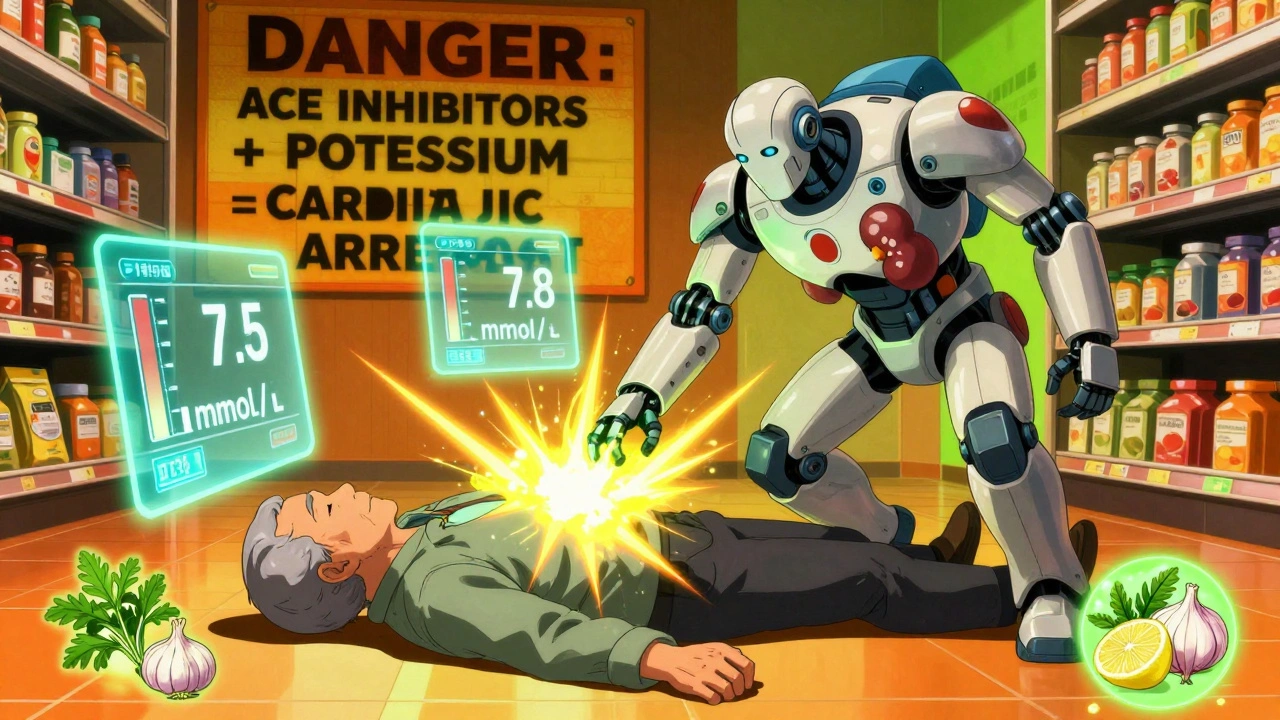
Hyperkalemia-high potassium in the blood-is often symptom-free until it’s too late. Levels above 5.0 mmol/L are considered elevated. Above 6.5 mmol/L? That’s a medical emergency. At that point, your heart’s rhythm can go haywire. Cardiac arrest isn’t just possible-it’s likely.
A 2004 case report in the Journal of the Royal Society of Medicine documented a 72-year-old man who went into cardiac arrest after using LoSalt for three weeks while taking nabumetone and already having mild kidney issues. His potassium level hit 7.8 mmol/L. He survived, but barely. That’s not an outlier. It’s a pattern.
People with chronic kidney disease (CKD) are at the highest risk. About 15% of U.S. adults have CKD, and nearly half of them are on ACE inhibitors or ARBs to protect their kidneys. That’s a dangerous overlap. A 2019 meta-analysis of over 1.2 million people found that for those with CKD stage 3 or worse (eGFR below 60), the rate of hyperkalemia jumped from less than 1 event per 100 people per year in the general population to nearly 9 events per 100 people per year when they used potassium salt substitutes.
Who’s Most at Risk?
It’s not just people with diagnosed kidney disease. If you have any of these, you’re in the danger zone:
- Diabetes, especially with kidney damage (up to 20% of diabetic CKD patients have hyporeninemic hypoaldosteronism-a condition that cripples potassium excretion)
- Age over 65 (kidney function naturally declines)
- Heart failure or taking diuretics like spironolactone
- Already have high potassium levels (above 4.5 mmol/L)
- Have an eGFR below 60 mL/min/1.73m²
Here’s the kicker: most people don’t know they’re at risk. A 2023 study in JAMA Internal Medicine found that 78% of patients on ACE inhibitors or ARBs had no idea dietary potassium could be dangerous. They saw "low sodium" on the label and assumed it was safe. No warning. No doctor talk. Just a shelf next to the regular salt.
What the Experts Say
There’s a split in the medical community. On one side, the 2025 JAMA study showed that for healthy adults, using a 25% potassium chloride salt substitute reduced stroke risk by 14% over five years. That’s huge. Dr. Sarah Anderer, the lead author, says the benefits outweigh the risks-for most people.
But nephrologists like Dr. Mark S. Segal warn that those results don’t apply to people with kidney problems or those on RAAS blockers. "You can’t generalize from a healthy population to someone with an eGFR of 40," he says. The American Diabetes Association and the National Kidney Foundation agree: for patients with CKD or diabetes, the risk is too high.
The FDA took notice. In May 2024, they proposed new labeling rules that would require potassium salt substitutes to carry clear warnings for people on ACE inhibitors or ARBs. Right now, only 3 out of 12 major brands do this voluntarily. Canada mandated it in January 2024. The U.S. is still catching up.
Real People, Real Consequences
Online forums are full of stories that sound like medical case reports.
One Reddit user with 4,200 karma wrote: "Woke up in the ER with potassium at 6.3 after using Heart Salt for three weeks while on lisinopril. They said I was 10 minutes from cardiac arrest."
A Drugs.com review from a 68-year-old in Michigan said: "Severe muscle weakness, fluttering heart. My doctor said it was the salt substitute and losartan. I stopped it immediately. I still get dizzy sometimes."
On Amazon, 7% of reviews from users who mentioned kidney issues said their doctor told them to stop using the product after bloodwork showed high potassium. The same reviews often mention a metallic aftertaste-something 28% of users complain about. But taste isn’t the issue. Safety is.

What You Should Do Instead
You don’t need potassium salt to lower your sodium. There are safer, just-as-effective ways:
- Use herbs and spices: oregano, garlic powder, smoked paprika, cumin, lemon zest. Mrs. Dash and similar blends cut sodium by 40-50% with zero potassium risk.
- Cook at home more. Over 75% of sodium comes from packaged and restaurant food. Making your own meals cuts sodium without any substitute.
- Choose fresh or frozen vegetables over canned. Rinse canned beans and veggies to remove up to 40% of the sodium.
- Read labels. Look for "no salt added" or "unsalted" versions of broths, sauces, and snacks.
These methods don’t give you the same instant salty punch, but they’re sustainable. And they don’t put your heart at risk.
What Your Doctor Should Be Asking
The National Kidney Foundation says doctors should ask every patient on ACE inhibitors or ARBs about salt substitute use-at every visit. Why? Because 63% of hyperkalemia cases in these patients come from hidden dietary sources, not pills.
If you’re on one of these medications, ask your doctor for a serum potassium test. Normal is 3.5-5.0 mmol/L. If you’re above 4.5 mmol/L and have an eGFR under 60, you should avoid potassium salt substitutes entirely. If your eGFR is between 45 and 60, talk to your doctor before using them. If your kidneys are healthy and your potassium is normal, you may be fine-but still, monitor it every 3-6 months if you use them regularly.
The Bigger Picture
The global salt substitute market is growing fast-projected to hit $2.3 billion by 2030. That’s because hypertension affects nearly half of U.S. adults. The public health goal of reducing sodium makes sense. But pushing potassium substitutes as a one-size-fits-all solution ignores biology.
The real solution isn’t replacing salt. It’s educating people. It’s labeling products clearly. It’s training doctors to ask the right questions. And it’s giving patients the tools to reduce sodium without risking their lives.
For now, if you’re on an ACE inhibitor or ARB, don’t touch the potassium salt. Your heart doesn’t need the extra burden. There are better, safer ways to protect it.
Can I use salt substitutes if I’m on ACE inhibitors or ARBs?
No, if you have kidney disease, diabetes, or your potassium levels are already high (above 4.5 mmol/L). Even if you feel fine, these medications slow how your kidneys remove potassium. Adding potassium chloride from salt substitutes can push your levels into a dangerous range, risking heart rhythm problems or cardiac arrest. If you have normal kidney function and your potassium is normal, talk to your doctor first-but even then, consider safer alternatives like herbs and spices.
What are the symptoms of high potassium?
Early signs are subtle: muscle weakness, fatigue, tingling, or nausea. As potassium rises, you may notice heart palpitations, chest pain, or irregular heartbeat. In severe cases, you can suddenly lose consciousness or go into cardiac arrest. Many people don’t feel anything until it’s too late. That’s why blood tests are critical if you’re on these medications.
How do I know if I have kidney disease?
Your doctor can check your eGFR (estimated glomerular filtration rate) and serum creatinine from a simple blood test. An eGFR below 60 mL/min/1.73m² for three months or more means you have chronic kidney disease. Many people don’t know they have it until they’re tested-especially if they’re diabetic or over 60. Ask for this test if you’re on ACE inhibitors or ARBs.
Are there salt substitutes without potassium?
Yes. Look for products labeled "sodium-free" or "potassium-free" that use other flavor enhancers like magnesium sulfate or monosodium glutamate (MSG). But the safest option isn’t a substitute at all-it’s using herbs, spices, citrus, and vinegar to flavor food. These give you flavor without any potassium or sodium risk.
How often should I check my potassium levels?
If you’re on an ACE inhibitor or ARB and have kidney disease, diabetes, or are over 65, get your potassium checked every 3 months. If your levels are normal and you have no kidney issues, once a year is usually enough-unless you start using salt substitutes. Never start a potassium-based salt substitute without checking your levels first.





Post A Comment